
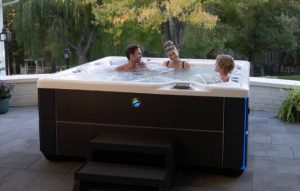
Short answer: in most New Jersey towns, yes. Even a portable spa that sits on the ground and plugs into a dedicated circuit usually needs a construction permit and zoning approval before it goes in.
That surprises a lot of people. A hot tub is not a swimming pool, it does not get dug into the ground, and it arrives finished on a truck. But New Jersey treats a spa as a permanent electrical and zoning matter, and the towns across our service area take it seriously. The good news is that the process is well worn, your electrician handles most of it, and it rarely delays a delivery if you start early.
Here is how it actually works.
The short answer for New Jersey homeowners
New Jersey enforces a single statewide code, the Uniform Construction Code, but each of the state’s 565 municipalities enforces it through its own construction office. That means the code is the same in Green Brook, Warren, Denville, and Toms River, while the paperwork, the counter hours, and the inspector’s preferences are all local.
For a typical backyard hot tub, expect three things:
- A construction permit, with the electrical subcode application filled out
- Zoning approval, confirming the spa’s location meets setback and coverage rules for your lot
- An inspection of the electrical work, including bonding and grounding, before you fill and use the spa
What the New Jersey Uniform Construction Code covers
Construction permit and electrical subcode
New Jersey’s construction code applies the 2018 International Swimming Pool and Spa Code with state modifications, and spas fall under it. In practice, the permit for a portable spa is driven almost entirely by the electrical work rather than the tub itself. Your application will include the electrical subcode technical section, and your electrician will typically submit wire sizes, the breaker rating, and the manufacturer’s installation instructions and spec sheet.
If you are also building something for the spa to sit on or beside, a pad, a deck, a pergola, or a privacy screen, that can pull in the building subcode as well.
Zoning review, setbacks, and impervious coverage
This is the part homeowners rarely see coming, and it matters more here than in most of the country. Many central New Jersey towns limit how much of your lot can be covered by hard surfaces. Roofs, driveways, patios, and walkways all count toward that limit, and a new concrete pad counts too.
On the smaller, older lots common across Green Brook, Dunellen, Bound Brook, Middlesex, and Plainfield, a homeowner who is already close to the coverage limit can run into trouble by adding a pad. Setbacks matter as well, since most towns will not let a spa or its equipment sit right on a property line.
None of this is usually a dealbreaker. It is a reason to have the conversation before you pick a spot, not after the tub is on the truck.
The safety cover exception to barrier requirements
Homeowners often assume a hot tub means a new fence. Usually it does not.
New Jersey’s adopted pool and spa code includes an exception: where a spa or hot tub is fitted with a lockable safety cover that complies with ASTM F1346, the area around it does not have to meet the full barrier requirements that apply to a swimming pool. A compliant cover has to latch, resist a child climbing onto or through it, and support significant weight without giving way.
Two practical notes. First, this exception is written into the state code but your local construction official is the one who applies it, so confirm before you assume. Second, the cover only protects you if it is actually latched. A locking cover left open is not a barrier.
Every new spa we deliver comes with a hard cover, and we carry replacement spa covers when an older one has waterlogged or lost its seal.
Electrical work: 240V circuits, GFCI, bonding and grounding
Most full size hot tubs run on a dedicated 240V circuit with a GFCI protected disconnect within sight of the spa but a required distance away from it. The disconnect lets someone cut power without reaching over the water.
New Jersey also requires a bonding and grounding certificate for a newly installed spa, or for one that has had work done affecting the bonding system. Bonding ties the metal components in and around the spa together so they cannot sit at different electrical potentials. Your electrician handles this, and the inspector will want to see it before the spa is filled and energized.
New Jersey does allow a homeowner to perform electrical work in their own owner occupied single family home, filing as an exempt applicant. Most people still hire a licensed electrician for a spa, because the bonding requirements are specific and a failed inspection costs more time than the work saves.
One clarification worth making, because it circulates online: the state’s annual electrical certificate of compliance for pools and spas applies to properties other than one and two family homes. If this is your house, you are not signing up for a yearly inspection.
When a 110V plug and play spa changes the picture
Smaller plug and play spas run on a standard 110V outlet, which removes the new circuit from the equation in some cases. It does not automatically remove the permit. Towns differ on whether a plug in spa still triggers a construction permit, and zoning still applies regardless of how the spa is powered. Ask your construction office directly rather than assuming.
Foundation and pad requirements
A filled hot tub with people in it is heavy, and it needs a level, continuously supported surface. The usual options are a poured concrete pad, a prefabricated spa pad system, or an existing patio that is level and sound.
Pavers can work if the base underneath is properly compacted, but settling is the most common problem we see on older installs. If you are putting a spa on a deck, that is a separate structural question and worth having a licensed professional look at the framing before delivery. Our pre-delivery instructions cover surface preparation in detail.
Who pulls the permit: you, your electrician, or your dealer
In most cases your electrician pulls the electrical permit, since they are the one performing the work and signing off on it. The homeowner or the electrician files the zoning piece.
Healthmate delivers, places, and starts up your spa, and we can connect you with electricians who install spas in these towns regularly and know what each construction office expects. We do not pull permits on your behalf. Getting your electrician involved before delivery is the single best thing you can do to keep the timeline clean.
Township notes for our service area
The code is uniform. The process is not. A few patterns worth knowing:
- Somerset and Union County towns, including Green Brook, Warren, Watchung, Bridgewater, Scotch Plains, and North Plainfield: expect standard construction and zoning review, with coverage limits worth checking on smaller lots.
- Middlesex County towns, including Piscataway, Dunellen, Middlesex, and Edison: same process, and access for delivery is often the tighter constraint on older streets.
- Morris and Ocean County towns, including Denville, Rockaway, Toms River, and Brick: some areas carry additional considerations such as flood zone review or wetlands buffers, depending on the property.
Every town publishes its own permit packet online. Search your town name plus construction permit, and look for the pool and spa or electrical subcode forms.
How long the process usually takes
New Jersey construction offices generally issue a permit within about twenty business days of a complete application, and many move faster than that on a straightforward spa. Inspections are scheduled after the work is done.
Realistically, if you order a spa and get your electrician moving in the same week, the electrical is usually ready by the time the tub arrives. The delays we see are almost always applications that sat on a kitchen counter for two weeks.
How Healthmate helps with your install
We have been delivering spas across New Jersey since 1998, and site planning is part of what we do rather than something we hand off. A free in-home consultation covers where the spa can go, how we will get it there, what the electrical run looks like, and what your town will want to see.
Come see what fits at our Green Brook showroom on Route 22, or browse hot tubs first and talk to a wellness consultant when you are ready.
Frequently asked questions
Do I need a fence around my hot tub in New Jersey?
Usually not, if your spa has a lockable safety cover that complies with ASTM F1346. New Jersey’s adopted pool and spa code exempts spas with a compliant cover from the barrier requirements that apply to swimming pools. Your local construction official makes the final call, and the cover has to be latched when the spa is not in use.
Can a homeowner do the electrical work themselves?
New Jersey permits a homeowner to perform electrical work in their own owner occupied single family residence, filing as an exempt applicant. You still need the permit and the inspection. Most spa owners hire a licensed electrician because the bonding and grounding requirements are specific and easy to get wrong.
Do I need a permit for an inflatable or plug and play hot tub?
Possibly. Some towns treat any spa, permanent or temporary, as requiring a construction and zoning permit, while others handle plug in units differently. Zoning rules apply either way. Call your construction office and describe exactly what you are installing.
What happens if I install a hot tub without a permit?
You can be required to open up completed work for inspection, remove the spa, or resolve the issue before selling the house, since unpermitted work shows up in a title or municipal search. Insurance claims involving unpermitted electrical work can also get complicated. The permit is cheap compared to any of that.
Does Healthmate handle the permit for me?
We do not pull permits, but we help you plan the install and can connect you with electricians who work in your township regularly. Start with a free in-home consultation and we will walk through what your town will need.