
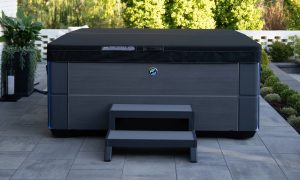
Your cover is the hardest working part of your hot tub and the one nobody thinks about. It sits out in the sun all summer, takes the snow load all winter, and gets lifted and dropped a few hundred times a year. Then one October evening you go to open it and realize you need two hands and a bit of a grunt, and it dawns on you that it did not used to be like that.
That extra weight is water. And a cover holding water is a cover that has stopped insulating.
Fall is the moment to deal with this. A tired cover in July is an annoyance. A tired cover in January is heat pouring out of your spa every hour of every day, on top of the risk that a heavy snow finishes the job and collapses it.
Seven signs your hot tub cover is finished
Go out and check yours. It takes two minutes.
It has gotten heavy. This is the big one. Cover foam is sealed inside a vapor barrier. When that barrier fails, the foam absorbs water and never gives it back. A cover that used to lift easily with one hand and now needs two is waterlogged, and no amount of drying will fix it.
The middle sags. Stand back and look at the profile. It should be slightly domed so rain and snowmelt run off. If there is a dip, or worse a puddle sitting in it, the foam core has broken down or the cover is bowing under its own soaked weight.
The vinyl is split or cracked. Once the outer skin opens up, water gets straight into the foam. Small tears near the hinge or the corners are the usual starting point.
The hinge seal has gone. The fold in the middle takes the most abuse. When the seal there tears, heat escapes right along the centerline, which is the worst possible place for it.
It smells musty. A sour or mildewy smell when you open the spa usually means moisture has gotten into the foam or the underside skin is degrading. That smell does not come out.
It does not sit flush. Look for gaps around the rim. A cover that has warped or shrunk lets steam out and cold air in continuously.
It is more than five to seven years old. That is the realistic service life around here. The tri-state weather cycle is hard on covers, and even a well cared for one is usually past its best by year seven.
Our hot tub maintenance FAQ has more on cover care and general upkeep.
What a worn out cover is actually costing you
We are not going to quote you a percentage, because the honest answer depends on your spa, your utility rate, and how bad the cover is. But the mechanism is straightforward.
Almost all of a hot tub’s standing heat loss goes upward through the water surface. The cover is the only thing in the way. When the foam saturates, its insulating value drops sharply, and the heater simply runs more to hold your set temperature. In a New Jersey winter, with a large temperature gap between the water and the air, that gap gets expensive.
There is a second cost too. A soaked cover is heavy enough to bend or break a cover lifter mechanism, and replacing a lifter on top of a cover is a worse bill than just handling the cover in time. We covered the broader running cost picture in what it actually costs to run a hot tub in New Jersey.
How to measure for a replacement cover
If you know your spa’s make and model, we can usually match it from that alone, which is the easiest route. If you have an older or unbranded spa, measure it yourself. Measure the spa’s acrylic shell, not the old cover, since the old one may have shrunk or spread.
- Length and width. Measure the outside edge of the acrylic lip at the widest points, in both directions. Round up to the nearest inch.
- Corner radius. Most spas have rounded corners. Fit a piece of cardboard into the corner, trace the curve, and measure from the corner point to where the curve begins. Square corners get recorded as zero.
- Skirt length. This is how far the cover flap hangs down the side. Four to five inches is typical.
- Fold direction. Note whether the cover folds across the length or the width. It matters for where the lifter goes and which way you approach the spa.
- Cutouts. Note any notches for railings, pillows, or a control panel.
Bring those numbers to any of our three showrooms, or send them along with a photo and we will confirm the fit. You can also browse the spa covers we carry to see the options.
What to look for in a new cover
Taper. A cover should be thicker at the center than the edges so water runs off instead of collecting. Flat covers puddle, and puddles become ice.
Foam density and thickness. Denser, thicker foam insulates better and resists sagging longer. It also weighs more, which is a real consideration if the person opening the spa most often is not the strongest person in the house. This is where a lifter earns its keep.
The vapor barrier. This is the sealed wrap around the foam and it is the single component that determines whether your cover lasts four years or eight. It is also the thing cheap covers skimp on, and you cannot see it once the cover is assembled. Ask.
Reinforced hinge. A heat sealed, reinforced hinge with an insulating flap keeps heat from escaping along the fold.
Marine grade vinyl. UV resistant, mildew resistant vinyl handles our summers much better than standard material.
Wind straps and locking hardware. Not optional in an open yard. They also keep the cover secured against children and pets, which matters year round.
Lifters and hardtop covers
If you are already replacing the cover, this is the natural moment to reconsider how you open it.
A cover lifter takes the weight out of the job and, just as importantly, keeps the cover off the ground where it collects grit and gets stepped on. Covers with a lifter reliably last longer than covers without one. Just check your clearance behind the spa first, since most lifters need 18 to 24 inches to fold back into.
There is also the hardtop route. Covana covers open with a key turn and lift the whole top away as a gazebo style canopy, so there is no folding, no lifting, and no cover sitting on the patio. They are a bigger commitment than a vinyl cover and they need to be planned for, but for anyone who has struggled with a heavy cover through a few winters, they solve the problem permanently.
You can see the full range on our accessories page.
Making your new cover last
- Never sit or stand on it, and do not let pets lie on it. Covers are rated to shed snow, not to carry weight.
- Do not use it as a table. One spilled drink into a seam is all it takes.
- Clean and condition the vinyl a few times a year with a product made for spa covers. UV damage is what starts most cracks.
- Rinse the underside when you change the water. Chemical vapor sits against it constantly.
- Take it fully off every few weeks in warm weather so the underside can dry out.
- Keep the locks fastened. Wind is a bigger threat to covers than snow.
Getting through a New Jersey winter
Brush snow off rather than letting it pile up, and use a soft broom rather than a shovel so you do not tear the vinyl. Do not try to chip ice off a frozen cover. Let it melt.
If you are expecting a heavy storm, throwing a tarp over the cover keeps meltwater from soaking into the seams as it refreezes. And if you are closing the spa down for the season rather than running it, that is a different job with real freeze damage risk if it is done wrong. Our guide on how to winterize a hot tub covers the steps, and we also offer professional winterization if you would rather not do it yourself.
Most of our customers run their spas straight through the winter, and honestly that is when a hot tub is at its best. A cover in good condition is what makes that comfortable and affordable.
Not sure what shape yours is in?
Send us a photo, or stop by Green Brook, Denville, or Toms River with your measurements. We will tell you honestly whether you have another season in it.
You can also schedule service if something else is going on with the spa, or shop covers and accessories in our online store.
Frequently Asked Questions
How long does a hot tub cover last?
Generally five to seven years in our climate. Covers kept on a lifter, cleaned and conditioned regularly, and never sat on tend to reach the upper end of that range. Covers left to take sun and snow without care often need replacing sooner.
Why is my hot tub cover so heavy?
It has absorbed water. The foam core is sealed inside a vapor barrier, and once that barrier fails the foam soaks up moisture and holds it. A heavy cover has stopped insulating properly and cannot be dried out or repaired.
Can a waterlogged hot tub cover be fixed?
No. Once the foam is saturated, replacement is the only real option. You can patch small vinyl tears to slow further damage, but that does not restore a core that has already taken on water.
How do I measure my hot tub for a new cover?
Measure the outside edge of the acrylic shell for length and width, then measure the corner radius by tracing the curve with cardboard. Note the skirt length, which way the cover folds, and any cutouts. Measure the spa itself rather than the old cover.
Do I need a cover lifter?
You do not need one, but it makes a real difference. A lifter removes the weight from opening the spa and keeps the cover off the ground, which extends its life. Check that you have 18 to 24 inches of clearance behind the spa before choosing one.
Should I put a tarp over my hot tub cover in winter?
It helps before a heavy snow or ice storm, since it keeps meltwater out of the seams. It is not something to leave on permanently, because trapping moisture underneath causes its own problems.