
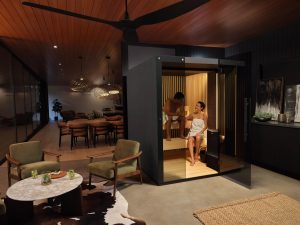
Almost everyone shopping for a home sauna arrives with the same question: infrared or traditional? It is the right question, but it is only half of it. The other half, and the one that decides more installs in New Jersey than anything else, is where the sauna is going to live in your house.
A damp basement, an unconditioned garage, and a spot in the backyard are three different projects. So is an older home with a panel that is already working hard. Here is how to think about both halves at once.
How each type actually heats you
Traditional Finnish sauna
An electric heater warms a bed of stones, the stones warm the air, and the hot air warms you. Temperatures run high, commonly somewhere in the 150 to 190 degree range at head height. You control the humidity by ladling water over the stones, which produces a burst of steam and a sharper wave of heat.
This is the sauna most people picture, and if you have used one in Finland, at a gym, or on a lake in Sweden, this is what you remember. It is a whole room experience: hot to breathe, aromatic cedar, the ritual of the water.
Infrared sauna
Infrared emitters warm your body directly rather than heating the air first. Because the air stays cooler, commonly in the 110 to 140 degree range, sessions feel gentler and many people find them easier to sit through for longer.
Practical advantages: infrared cabins generally warm up faster, draw less power, and are easier to fit into a finished space. If someone in the household finds a traditional sauna too intense, infrared is usually the answer.
Hybrid cabins
A hybrid gives you both in one room: a traditional heater plus infrared emitters, used separately or together. You get the full heat and steam of a Finnish sauna when you want it and the gentler infrared session when you do not, or when you are short on time.
Hybrids cost more and need the electrical capacity of a traditional sauna. For households where two people want different things, they solve the argument.
Temperature, humidity, and session length compared
| Traditional | Infrared | Hybrid | |
| Air temperature | Roughly 150 to 190 F | Roughly 110 to 140 F | Either, depending on mode |
| Humidity | Low, with steam bursts you control | Dry | Either |
| Heat up time | Longer | Shorter | Depends on mode |
| Typical session | Shorter, often 10 to 20 minutes | Longer, often 20 to 40 minutes | Either |
| Power draw | Highest | Lowest | Highest |
| Best for | The classic experience, steam, social use | Gentler heat, quick sessions, easier installs | Households that want both |
Whichever you choose, start conservatively, come out when you have had enough rather than when a timer says so, and drink water. There is no prize for staying in longer.
Where the sauna goes in a New Jersey home
Basements: moisture, ventilation, and floor drains
The basement is where most New Jersey home saunas end up, and it is a good choice with a few local caveats.
Basements in this part of the state tend to run humid, particularly in summer. A traditional sauna adds moisture to that environment, so ventilation is not optional. You want air movement in the room the sauna sits in, and ideally a dehumidifier already doing its job down there. An infrared cabin adds far less moisture, which is one reason it is a common basement choice.
Other things to check: ceiling height, since most cabins need something in the region of seven feet; a floor that can handle occasional water; and access, because a cabin has to physically get down your basement stairs. Measure the stairwell turn before you fall in love with a six person cabin.
Garages and unconditioned spaces
Workable, and popular with people who do not want a sauna in the finished part of the house. Bear in mind an unconditioned New Jersey garage swings from below freezing to very warm across the year, which means longer heat up times in winter and more attention to where you undress and cool down. A garage sauna is often better with a small conditioned vestibule or at least a plan for February.
Spare bathrooms and closets
A rarely used spare bath is one of the best sauna locations in a house: the floor is already water tolerant, there is usually ventilation, and a shower is right there for a cool rinse. Small infrared cabins fit into spaces people write off.
Outdoors
Outdoor cabins keep the heat and moisture out of the house entirely and make the whole thing feel like an event. They do need an electrical run to the location and a prepared base. If you are leaning this way, our guide to using an outdoor sauna through a New Jersey winter covers what to expect.
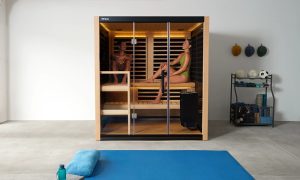
Electrical requirements and your panel
This is where a lot of sauna projects in older New Jersey housing stock get interesting.
Small infrared cabins can sometimes run on a dedicated standard household circuit, which makes them the easiest installs. Larger infrared cabins and essentially all traditional heaters need a dedicated 240V circuit, and the bigger the heater the more capacity it wants.
If your home still has an older service panel that is already close to full, the sauna choice becomes partly an electrical question. It is worth having an electrician look at your panel before you settle on a model, because a service upgrade can cost more than the difference between two cabins.
We will give you the actual electrical requirement from the specification sheet for any model you are considering. Do not plan around a general rule of thumb here.
What drives sauna cost
Cabin size and seat count
The single biggest factor. A two person cabin and a six person cabin are different products with different heaters, and be honest about how many people will realistically be in there at once.
Wood species and finish
Cedar, hemlock, spruce, and thermally modified woods all behave and look different and sit at different price points. For an outdoor cabin in New Jersey, where freeze and thaw cycling works on exterior wood every winter, species and finish matter more than they do indoors.
Heater and controls
Heater output, whether it takes stones, and how the controls work, from a simple dial to a scheduler you run from your phone.
Install and electrical work
Many cabins are designed for straightforward assembly. Custom cut rooms built into a space are a different scope. The electrical is usually the line item people forget to budget.
Our sauna pricing guide walks through what sits at each level.
A simple way to decide
- You want the classic experience, steam, and real heat: traditional.
- You want gentle heat, quick sessions, or the simplest install: infrared.
- Two people in the house want different things: hybrid.
- Your panel is tight or the space is finished and dry: lean infrared.
- You want it outdoors and year round: traditional, sized for the climate.
See both types running in our showroom
Fifteen minutes in each settles the question faster than any article. Come sit in a traditional cabin and an infrared cabin back to back and see which one your body prefers.
Shop saunas, browse traditional saunas, infrared saunas, and hybrid saunas, or see the Golden Designs range. Check sauna inventory for what is on the floor now, and the sauna FAQ for anything not covered here.
Frequently asked questions
Is infrared or traditional sauna better?
Neither is better in general, they are different experiences. Traditional gives you high heat, steam, and the classic ritual. Infrared gives you gentler warmth at a lower air temperature, faster heat up, and an easier install. The best way to choose is to sit in both.
How hot does an infrared sauna get?
Typically somewhere in the 110 to 140 degree range, well below a traditional sauna. Because infrared warms your body directly rather than the air, the session still feels intense even though the air temperature is much lower.
How long should a sauna session last?
Traditional sessions are commonly 10 to 20 minutes, infrared sessions often 20 to 40. Start shorter than you think you need, come out when you have had enough, and drink water. If you have any health condition or take medication, check with your doctor before starting.
Does a home sauna need a dedicated circuit?
Usually yes. Traditional heaters and larger infrared cabins need a dedicated 240V circuit. Some small infrared cabins can run on a dedicated standard household circuit. Get the requirement from the specification sheet for your model and have an electrician confirm your panel can carry it.
Can you put a sauna in a New Jersey basement?
Yes, and it is the most common location we see. Plan for ventilation, since basements here already run humid, and check ceiling height and whether the cabin can physically get down the stairs. Infrared cabins add less moisture to a basement than traditional ones.