
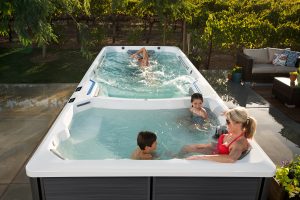
If you are weighing a swim spa against an inground pool, the deciding factor in New Jersey is not really cost. It is the calendar.
An unheated pool in this state is comfortable from somewhere around late May to early September. Call it three months, maybe three and a half in a warm year, and less than that if you are honest about the June mornings and the September evenings. A swim spa runs at whatever temperature you set, in February, in a snowstorm, at six in the morning before work.
That is the trade. Everything else follows from it.
The New Jersey season problem
How many months you actually swim in an unheated pool here
Homeowners who grew up with a pool tend to overestimate their own usage. Between school schedules, weather, and the fact that nobody gets in when the water is 68 degrees, a typical New Jersey pool sees real use for about a quarter of the year. The other nine months it is covered, closed, or a thing you look at through a window.
Heating an inground pool extends the season, and it also puts a serious number on your utility bill because you are heating tens of thousands of gallons in open air.
What year round use changes
A swim spa holds a much smaller volume of water under an insulated cover, so keeping it warm all winter is a manageable cost rather than an extravagant one. That changes what the thing is for. It stops being a summer amenity and becomes part of your week: swim training, aquatic exercise, a warm soak after shoveling the driveway.
Twelve months of use versus three is the entire argument, and it is worth doing that math on your own household before you look at any other number.
Side by side comparison
| Swim spa | Inground pool | |
| Usable season in New Jersey | Year round | Roughly three months unheated |
| Footprint | Typically 12 to 20 feet long | Usually 30 feet or more, plus decking |
| Install time | Delivery and startup, often a single day once the site is ready | Weeks to months of excavation and construction |
| Permits in New Jersey | Construction and zoning permit, electrical inspection | Construction permit, zoning, engineering review, barrier requirements |
| Yard impact | Sits on a prepared pad, reversible | Permanent change to the property |
| Winter | In use | Closed and covered |
| Water volume to treat | Hundreds to a few thousand gallons | Tens of thousands of gallons |
| Swim training | Continuous current, no turns | Length dependent, turns every few strokes |
| Hosting a crowd | Limited | Excellent |
Footprint and yard impact
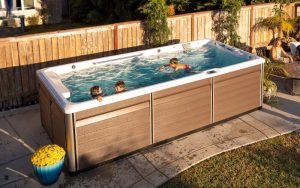
This matters on New Jersey lots. A swim spa fits in yards where a pool simply cannot go, and it does not consume the entire yard when it does fit. It also does not permanently commit the property. If you move, a swim spa can go with you.
Install timeline
A pool is a construction project with a crew, a schedule, weather delays, and a sequence of inspections. A swim spa is a delivery. You prepare the pad and the electrical ahead of time, we place it, fill it, and start it up.
Permitting and zoning in New Jersey
Both need permits. The pool needs more of them. New Jersey enforces a statewide construction code through each municipality, and inground pools bring in zoning, engineering review, barrier and fencing requirements, and a longer inspection sequence.
A swim spa is treated much like a large hot tub: a construction permit, zoning approval, and an electrical inspection including bonding and grounding. Worth knowing, many towns limit how much of your lot can be covered by hard surfaces, and pool decking eats into that allowance far faster than a swim spa pad. Our guide to permits for spas in New Jersey walks through the process.
Ongoing upkeep and winterization
A pool gets opened in spring and closed in fall, both of which are jobs or invoices. Through the season you are managing a large volume of open water that collects everything the wind brings. A swim spa is covered when not in use, holds a fraction of the water, and is never winterized because it never shuts down.
Cost: what drives the number on each side
We are not going to quote you a pool, and we would be suspicious of anyone who does it in a blog post. What we can do is tell you what moves the number.
For an inground pool: excavation and site access, shell type, decking and hardscape, required fencing, utility work, heater, cover, and landscaping to repair what the excavator drove over. The build price is the beginning, not the end.
For a swim spa: model and series, size and current system, site preparation, the electrical run, and any surround or decking you add. Delivery and startup are a defined scope rather than an open ended project.
Then look at annual cost honestly on both sides: energy, chemicals, opening and closing, and repairs. A pool’s running cost is concentrated into the months you use it. A swim spa’s is spread across a year in which you use it constantly.
When you are ready for real figures on the swim spa side, request pricing and we will put together something specific to the model and your site.

What a swim spa does that a pool cannot
Current based swim training
You swim in place against a current, which means continuous stroke work with no turns and no wall. For anyone actually training rather than splashing, that is better practice than a residential pool, where you are turning every four or five strokes.
Hydrotherapy and recovery
Most swim spas include warm seating with jets, so the same unit covers exercise and recovery. That is a genuinely different proposition from a pool plus a separate hot tub.
Aquatic exercise in cold months
Low impact work in warm water is exactly what a lot of people want in January, and it is precisely when a pool is unavailable. Water walking, resistance work, and range of motion exercise all continue through the winter.
What a pool does that a swim spa cannot
Being straight about this matters. A pool hosts a birthday party. It holds a dozen kids. It lets people float around aimlessly on a hot Saturday in a way a swim spa does not. If summer entertaining for a crowd is the point of the project, a pool is the right answer and we will tell you so.
Some households end up doing both, and some pool owners add a swim spa for the nine months the pool is closed.
Choosing between the Endless Pools series
We carry Endless Pools swim spas in three families, and the right one depends on what you are actually doing in it.
- Endless Pools Fitness Systems for the most serious swim experience, with the propulsion technology the brand is known for.
- SwimCross Exercise Systems for jet driven swimming and exercise across a range of workouts.
- RecSport Recreation Systems for families who want open water for play, movement, and relaxing rather than lap training.
See current swim spa inventory or read the swim spa FAQ.
Come try it before you decide
Reading about a current is not the same as swimming against one. Get in touch about a test swim and feel the difference between the series for yourself, then decide. We have been putting swim spas into New Jersey backyards since 1998, and we would rather you choose the right thing than the expensive thing.
Shop swim spas or request pricing.
Frequently asked questions
Can you use a swim spa in the winter in New Jersey?
Yes, and that is most of the point. A swim spa holds a relatively small volume of water under an insulated cover, so it stays at your set temperature through a New Jersey winter. Many owners use theirs more in the cold months than in July.
Does a swim spa need a permit in New Jersey?
In most towns yes. Expect a construction permit, zoning approval, and an electrical inspection including bonding and grounding. It is a lighter process than an inground pool, which also brings in engineering review and barrier requirements. Confirm specifics with your local construction office.
How much does a swim spa cost to run?
Considerably less than heating an inground pool, because you are holding a much smaller volume of water under a cover rather than heating open water. Your actual figure depends on the model, your set temperature, and your utility rate. Ask us and we will work it out against your electric bill.
Do swim spas add value to a New Jersey home?
A swim spa is generally treated as personal property rather than a permanent improvement, which cuts both ways: it may not appraise into the house the way a pool can, and it also does not narrow your buyer pool or commit the yard. If you move, it can come with you.
How deep is a swim spa?
Deep enough to swim and exercise in without being a diving pool, typically in the range of four to five feet depending on the model. Exact depth varies by series, and we will give you the figure for whichever one you are considering.